
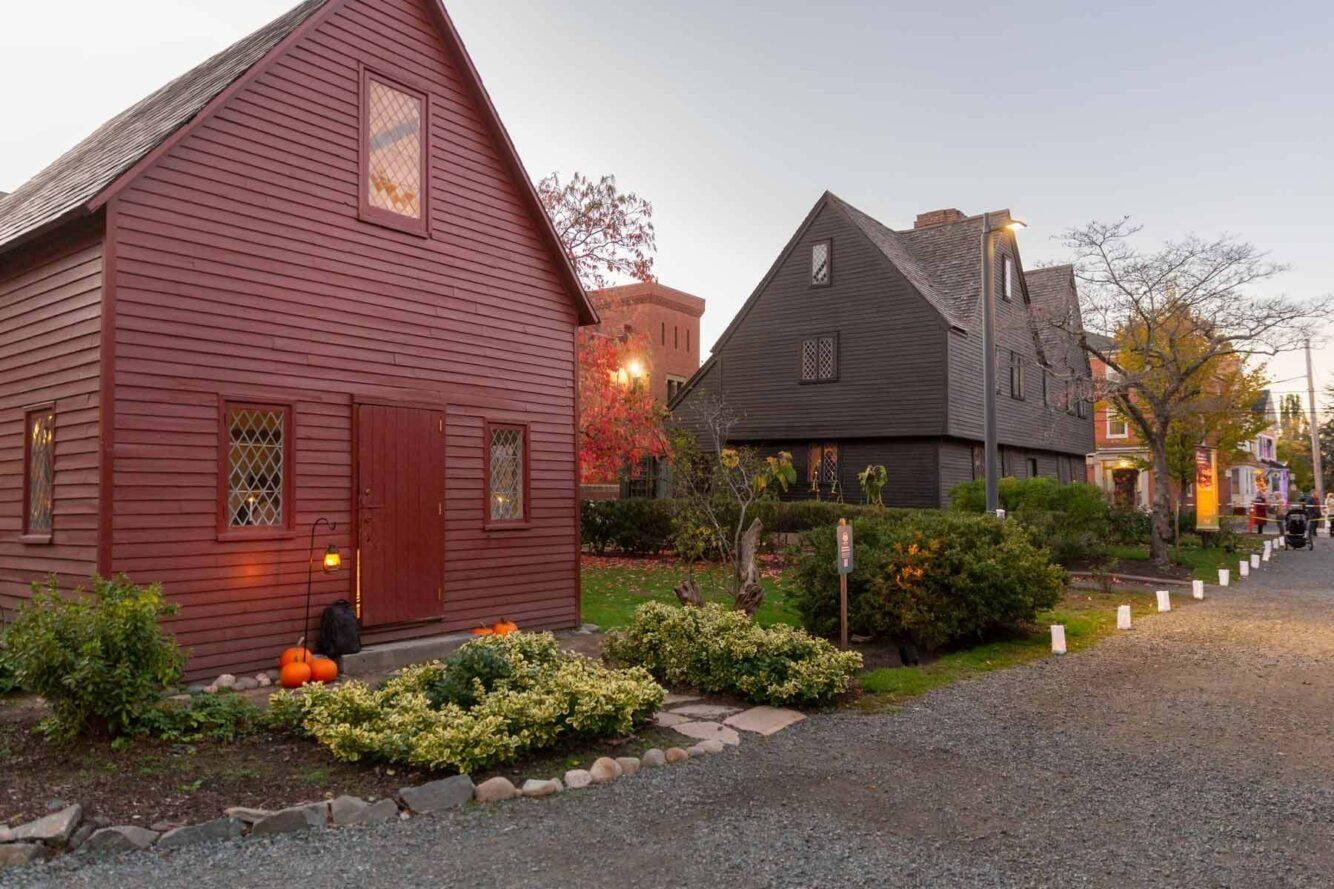
When we think about the Salem Witch Trials, we often picture frightened villagers, accusations of witchcraft, crowded courtrooms, and innocent people being led to the gallows. But what happened when the trials ended? What was life like for the people who remained in Salem? How did neighbors who had accused one another of practicing witchcraft return to living side by side? What became of the children who had made the accusations? And how did a community recover from one of the darkest chapters in early American history?
By the fall of 1692, the witchcraft hysteria that had swept through Salem and surrounding Massachusetts communities was beginning to lose its grip. Twenty people had been executed. Nineteen were hanged, and one man, Giles Corey, was pressed to death beneath heavy stones. Others died while imprisoned. More than 200 people had been accused of witchcraft, and families had been devastated by imprisonment, executions, and the loss of their property and livelihoods.
In October 1692, Governor William Phips dissolved the special court responsible for the trials. The remaining cases were handled by a new court that no longer accepted the controversial spectral evidence used to convict many of the accused. By May 1693, the remaining prisoners had been released. The legal proceedings were finally over. But ending the trials did not erase what had happened.
Imagine returning to your farm after months in prison, only to discover that your crops had gone untended, your animals had been neglected, and your neighbors were the very people who had accused you of witchcraft.
Voices of Salem Village
To understand life after the trials, it helps to understand that Salem was not one small village. Salem Town was a growing coastal community where merchants, fishermen, shipbuilders, and tradesmen made their living. Several miles inland, Salem Village was primarily an agricultural settlement, with families working farms and raising livestock. Salem Village, now part of Danvers, Massachusetts, had experienced deep divisions long before the first witchcraft accusations. Disputes over property, church leadership, taxes, and community authority had created bitter disagreements between families. The trials made those divisions considerably worse.
Some families eventually left the area rather than continue living among those they believed had wronged them. The Nurse and Cloyse families, among others, had connections to the movement of former Salem residents into what became Framingham, Massachusetts. For some, starting over somewhere else offered a better future than remaining in a community filled with painful memories.
Despite the tragedy, life in colonial Salem continued much as it had before the trials. For farming families, survival depended on the seasons. Spring meant preparing fields and planting crops. Summer brought long days of tending vegetables, caring for livestock, and maintaining homes and barns. Autumn was harvest time, when families gathered and preserved enough food to survive the coming winter. Winters in Massachusetts could be brutal. Homes were heated by fireplaces, and firewood had to be cut and stored.
Children were expected to contribute to the household. Boys often helped with farming, livestock, and other physical labor. Girls commonly assisted with cooking, spinning, sewing, and caring for younger children, although duties varied from family to family. Religion remained central to daily life. The Puritan faith influenced laws, education, family relationships, and expectations of proper behavior. And yet, one can only wonder how different those Sunday services must have felt after the events of 1692.
Samuel Sewall, one of the judges involved in the proceedings, publicly acknowledged his responsibility and expressed remorse. Twelve jurors also issued an apology. Not everyone followed their example.
Voices of Salem Village
In January 1697, the Massachusetts government called for a day of fasting and prayer in recognition of the colony's wrongdoing, including the witch trials. Perhaps one of the most remarkable acknowledgments came from Ann Putnam Jr. In 1706, fourteen years after the trials, Ann publicly acknowledged her role and expressed sorrow for the harm she had caused. She was approximately 27 years old. Her statement described how she believed she had been deceived and acknowledged that innocent blood had been shed. It was an extraordinary admission, particularly in a society where reputation and religious standing were so important.
Abigail Williams was only about eleven years old when the accusations began in 1692. Living in the household of her uncle, the Reverend Samuel Parris, Abigail became one of the central figures in the accusations that ignited the witchcraft panic. Yet, strangely enough, Abigail largely disappears from the surviving historical record after the trials. We do not know with certainty where she went, whether she married, whether she had children, or when she died. One of the most recognizable names associated with the Salem Witch Trials simply vanishes from recorded history.
As the eighteenth century progressed, Salem began transforming into an increasingly important commercial port. Fishing, shipbuilding, and maritime trade brought new opportunities to the coastal community. In Salem Village, Reverend Samuel Parris left his position in 1696, helping open the way for attempts to restore peace within the divided congregation. Over time, new generations grew up who had not personally witnessed the trials. For them, the events of 1692 became stories told by parents and grandparents.
Although the trials ended in 1693, the effort to correct the injustice took generations. In 1702, the Massachusetts General Court declared the trials unlawful. In 1711, the colonial government passed legislation restoring the legal standing of many of those convicted and authorizing financial compensation for victims and their families. But these actions were incomplete. Not every victim was included, and no amount of money could restore the lives that had been lost. Remarkably, in 2022, Massachusetts formally exonerated Elizabeth Johnson Jr., whose conviction had remained unresolved for more than three centuries. It had taken 330 years to finish clearing the names of those wrongfully convicted.
The people of Salem were not characters in a horror story. They were ordinary people living in an extraordinarily difficult time — and fear, suspicion, and personal disagreements overwhelmed their ability to distinguish truth from rumor.
Voices of Salem Village
The Salem Witch Trials are often presented as a story about superstition, religion, and a belief in witchcraft. But the greater lesson concerns something much more familiar: fear. Fear of people who are different. Fear of things we do not understand. Fear of speaking out when everyone around us seems convinced that something terrible is happening. What makes the story particularly troubling is that we cannot dismiss it simply by saying people were less educated or more superstitious three centuries ago. Human nature has not changed nearly as much as our technology. We still see rumors spread. We still see people accused before the facts are known. And we still see communities divided by fear and mistrust. The history of Salem reminds us why evidence, fairness, and the courage to question popular opinion matter.
One of the reasons I became interested in the Salem Witch Trials was the mystery surrounding Abigail Williams. We know she was a real child who played a significant role in one of America's most tragic historical episodes. But we know remarkably little about the rest of her life. That mystery helped inspire my middle-grade fantasy adventure, Abigail's Legacy: Mike's Discovery. The story takes place in present-day Durham, Maine, where twelve-year-old Mike Williams discovers that his family history may hold secrets reaching back to colonial Salem. The novel is fiction, and its supernatural elements are products of my imagination. But the historical events that inspired the story were very real.